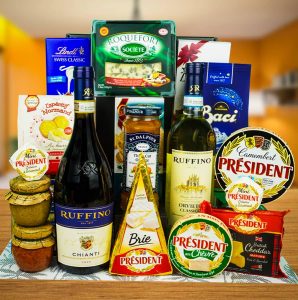
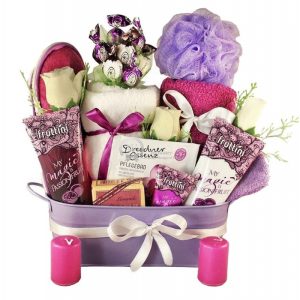
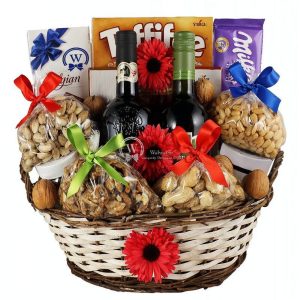
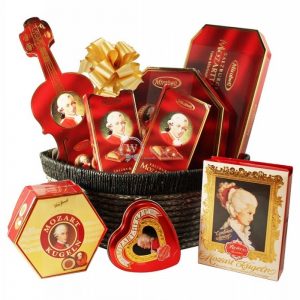
US and UK buyers struggle to vet European gift vendors because the usual signals- English-language reviews, website polish, provenance claims- don't hold up across language and market borders. The fix isn't more browsing. It's using verifiable tools (VAT registry checks, national business registries, written terms, sample orders) or working with an EU-based vendor built specifically for international corporate buyers.
You find a European gift supplier online. The website looks polished. The products look beautiful. The prices seem reasonable. You place the order for thirty corporate hampers.
Six weeks later, twelve arrive late, four are stopped at customs, two go to the wrong addresses, and the rest contain products that bear no resemblance to the photos. You have no local contact, no easy legal recourse, and a client list that’s quietly unimpressed.
This page explains why that keeps happening to otherwise careful buyers, and what to check before you commit a corporate gifting budget to a European vendor you’ve never met.
Key Takeaways
- Website polish and English-language reviews are weak signals on their own. A convincing e-commerce site can be built in a weekend, and many of the international reviews a supplier shows you may have been actively cultivated for exactly that purpose.
- Every legitimate EU business has a VAT number, and you can check it for free in under a minute using the European Commission’s VIES tool.
- National business registries (Companies House in the UK, Handelsregister in Germany, the RCS in France, the KVK in the Netherlands, and similar registers elsewhere) let you confirm a company actually exists and how long it’s been trading.
- Vague provenance language such as “artisan,” “locally sourced,” or “traditional” has no legal definition in most EU markets and can’t be verified from outside the country.
- Cross-border B2B disputes in Europe are slow and expensive to pursue, so your payment method, not the legal system, is usually your real protection.
- European peak seasons don’t line up neatly with US and UK expectations. A supplier that responds quickly in October can be at capacity by December.
- A small sample order, a written substitution policy, and a named contact are the three cheapest ways to test a new vendor before placing a large corporate order.
The Trust Gap: Why Vetting EU Vendors From Abroad Is So Difficult
There’s a well-documented pattern in international e-commerce: the further a buyer is from a supplier, the harder it is to judge quality, reliability, and legitimacy. For US and UK companies sourcing corporate gifts in Europe, this gap is wide, and getting it wrong is expensive.
The problem isn’t that European gift vendors are less trustworthy than domestic ones. It’s that the usual due-diligence tools, review platforms, professional networks, trade press, and word of mouth don’t translate cleanly across language and cultural lines. A supplier who’s well-regarded locally may have almost no footprint on the platforms a US or UK buyer checks.
The reverse is also true. A supplier who has invested heavily in English-language SEO and English-language reviews may have done so precisely because their local reputation isn’t strong enough to carry the business on domestic referrals alone. A European vendor being easy for an English speaker to find can, oddly, be a mild warning sign rather than a reassuring one.
The Seven Vetting Failures US and UK Buyers Keep Making
These aren’t hypothetical risks. They’re the failure patterns that procurement teams and executive assistants describe again and again when explaining what went wrong with a European gifting program.
- Trusting English-language reviews on English-language platforms. Trustpilot, Google Reviews, and similar platforms collect reviews from people who use them, and in many European countries the regular review-writers skew toward a demographic that has little to do with B2B corporate gifting. A Dutch gift company might have twelve English-language Google reviews from international buyers and two hundred reviews on a Dutch platform a UK buyer has never heard of. Only the English reviews show up in a UK or US search, and they tell a partial story at best.
- Mistaking website quality for product quality. Website design is commoditized now. A professional-looking store can be built in a weekend with a template and stock photography. Basket photos on many European gift sites are stock images, aspirational shots of products the supplier doesn’t actually stock, or a single premium item photographed to represent a mediocre range. The correlation between site quality and business quality, which US and UK buyers rely on instinctively, holds far less reliably here.
- No way to verify product provenance. Terms like “artisan,” “locally sourced,” “traditional,” and “premium” carry no legal definition in most EU markets and require no proof. A basket described as “selected European artisan products” might be sourced from a central distributor and repackaged under the supplier’s own label. You can’t visit the farm, attend the market, or ask a trusted local contact whether a claimed producer relationship is real. You’re relying entirely on what the supplier tells you.
- Underestimating language-dependent red flags. Vetting a domestic supplier comes with a natural filter: you can read the local reviews, the forum threads, the trade press, the complaints. You’d notice a pattern of late delivery or product substitution because it would surface in your normal reading of the market. That filter disappears in a foreign-language market. The red flags exist; you just can’t see them.
- No visibility into local fulfillment capacity. Corporate gifting at scale needs warehouse space, packing staff, reliable carriers, and quality control, none of which is visible from a website. A European supplier who serves their domestic market well with a small team may be unable to scale for a large international order at peak season. Buyers often discover this only after the order is placed, when the delivery window quietly slips because the order exceeded what the operation could handle.
- Misunderstanding EU payment and dispute resolution. When a domestic supplier fails to deliver, you know which trading standards body to contact and how to escalate. Cross-border B2B disputes in Europe work differently: EU consumer protection is strong for individual consumers but far less automatic for business-to-business transactions, and enforcement is slow, expensive, and dependent on jurisdiction. Most US and UK businesses who’ve been let down by a European supplier simply absorb the loss, because the alternative is a foreign legal process with an uncertain outcome.
- Peak-season opacity. European gifting peaks don’t line up with US and UK assumptions. German suppliers often reach capacity by late November; Spanish suppliers sometimes extend into early January; Scandinavian markets see an additional peak around Midsummer. A supplier who replies quickly in September may be in a completely different operational state by December. Expectations around response time also differ by market, so a slow reply that a UK buyer reads as unprofessional might be entirely normal elsewhere, and a fast, responsive supplier in one country might have a skeleton client-services team over the August holiday period.
Vetting Signals at a Glance
Not every signal tells you what it looks like it tells you. This table separates what a signal appears to prove from what it actually confirms.
Signal | What It Seems to Prove | What It Actually Confirms |
|---|
Polished website | Established, reliable business | Only that someone paid for good design |
English-language reviews | Strong reputation | Reputation among a narrow international slice, not the domestic market |
“Artisan” or “locally sourced” claims | Verified product origin | Nothing, unless the supplier names specific producers or regions |
Fast email response in autumn | Good customer service | Current capacity only, not December capacity |
Valid VAT number (VIES) | Legitimate registered business | Registration status, not service quality or reliability |
Listed on a marketplace platform | Vetted by a third party | Consumer-order accountability, which rarely covers B2B volume or damages |
Willingness to provide a sample order | Confidence in the product | Willingness to be tested, which is itself a useful signal |
How to Vet a European Corporate Gift Vendor: A Six-Step Process
- Check the VAT number. Every legitimate EU business has one. The European Commission’s VIES tool checks it for free in under a minute and returns the registered business name and address when available. An invalid or unverifiable number isn’t automatically disqualifying; some small national databases lag, but a supplier who can’t provide a checkable number at all is a real concern.
- Look up the national business registry. The UK has Companies House, Germany has the Handelsregister, France has the Registre du Commerce et des Sociétés, the Netherlands has the KVK, and most other EU countries maintain an equivalent public register. These confirm the company exists, how long it’s been trading, and sometimes its filing history.
- Ask for provenance in specific terms. Push past “artisan” and “locally sourced.” Ask which producers, which region, which certification, if any. A supplier who answers specifically is demonstrating real supply chain knowledge; one who repeats the marketing language is not.
- Request a written policy on substitution and delivery. What happens if a product is unavailable? What’s the delivery guarantee, and what’s the remedy if it’s missed? Get this in writing before you order, not after something goes wrong.
- Place a small sample order first. Before committing to thirty or a hundred units, order a handful and check what actually arrives against what was described. This is the cheapest insurance available, and most legitimate suppliers will accommodate it.
- Choose a payment method with recourse. Cross-border B2B legal remedies are slow and expensive to use. A credit card or a payment platform with buyer protection gives you a realistic path to a refund if something goes wrong; a bank transfer to a new vendor generally doesn’t.
Bridge Distances with Corporate Gifting: Planning gifts for teams and clients across the US and UK? Click Here
The False Reassurance of Marketplace Platforms
A natural instinct is to use large marketplace platforms, Amazon Business, Not On The High Street, Etsy, or similar, as a proxy for vetting. The logic is sound on the surface: these platforms have review systems, dispute resolution, and seller standards that suggest a framework of accountability.
For individual consumer purchases, that logic mostly holds. For professional corporate gifting at scale, it breaks down in a few specific ways:
- Volume and customization. Marketplace sellers are typically built for individual consumer orders. Corporate gifting needs multiple delivery addresses, custom branding, account invoicing, and reliable scale that most marketplace sellers aren’t set up to provide.
- Product representation. Marketplace photos usually show a single, carefully chosen specimen. A corporate order of fifty baskets may be fulfilled from a different production batch than the one photographed.
- Accountability gaps. Marketplace dispute resolution is designed for consumer transactions. A missed client event, a damaged business relationship, or reputational fallout from a botched corporate order falls well outside what any marketplace platform will resolve.
- Seasonal reliability. Marketplace sellers can go offline, close temporarily, or change how they fulfill orders during peak periods without the kind of notice a corporate buyer depends on.
What the Vetting Problem Actually Costs
The financial costs of a failed European gifting program are easy to quantify: replacement orders, expedited shipping, credits issued to affected clients, staff time spent fixing the problem. These are real and often significant.
The harder-to-quantify costs are often higher:
- Client relationship damage. A corporate gift that arrives late, incomplete, or wrong isn’t a neutral event. It signals disorganization and poor judgment. The client who received the wrong basket in November may not renew in January.
- Internal credibility. The person who recommended the supplier takes a credibility hit when the program fails, and future gifting budgets can get cut or reassigned as a result.
- Opportunity cost. Hours spent chasing suppliers, handling complaints, and arranging replacements are hours not spent on higher-value work.
- Reputational signal. How a company manages client gifting is, in some industries, a genuine signal of how it manages client relationships generally. Getting it wrong repeatedly says something.
The Structural Solution: Remove Yourself From the Vetting Problem
Once the information asymmetry is clear, the rational response isn’t to research harder. The information you’d need to properly vet a European vendor from the US or UK often isn’t practically accessible to you, no matter how much time you spend on it.
The more useful response is to find a supplier whose trustworthiness doesn’t depend on your ability to perform that due diligence, because someone inside the market has already done it properly.
That means working with a corporate gift service that:
- Has operated within the EU for a meaningful period, with a track record you can check against a registry
- Has named, specific relationships with its product suppliers, not vague provenance claims
- Specifically serves international corporate clients, with the infrastructure to handle multiple addresses, custom branding, and account management
- Offers clear, written terms on delivery, product substitution, and dispute resolution
- Is reachable by phone or email in English and responds within a professional timeframe
- Can provide references from other international corporate clients on request
Many European gift suppliers satisfy some of these. Fewer satisfy all of them. The ones that do represent a genuinely different risk profile from the long tail of visually polished, operationally unverifiable options that dominate a typical search.
The Solution for US and UK Companies: Walwater Gifts
For US and UK businesses with European clients, partners, or employees to gift, Walwater Gifts is built as the kind of pre-vetted, internationally oriented EU specialist that sidesteps the vetting problem rather than asking you to solve it from a distance.
EU-based, EU-sourced, EU-delivered. Walwater sources products from within the EU and delivers within the EU. For US companies, that means no transatlantic shipping complications or customs friction. For UK companies, it means avoiding the post-Brexit Export Health Certificate requirements, import duties, and carrier surcharges that make UK-origin European gifting expensive and unreliable.
Supply chain transparency. Walwater’s product curation is built on genuine producer relationships that can be described specifically, rather than the vague “artisan and locally sourced” language that covers a multitude of supply chain gaps. Ask where a product comes from, and you get a real answer.
Corporate infrastructure, not a consumer storefront. Walwater is built for business accounts: multiple delivery addresses across the EU from a single order, custom branding and messaging, and the kind of account handling procurement teams expect. Corporate branded orders generally need one to two weeks of preparation, depending on quantity, so it’s worth planning ahead rather than ordering at the last minute.
English-language service, European operations. Walwater serves international clients in English, so communication is direct, without translation tools or time-zone guesswork for a basic inquiry. The operations are European; the client-facing experience is built for US and UK business buyers.
Dietary and cultural awareness across the EU. A European client list isn’t uniform. Walwater’s curation accounts for the dietary, cultural, and regulatory variation across EU member states, alcohol-free options and allergen-declared ranges among them, so a gift program can work across a full recipient list rather than most of it. Availability of specific options may vary by destination and season, so it’s worth checking the product page and delivery details before ordering.
Every corporate order includes a personalized message printed on a designed greeting card, so the gift arrives with a professional touch rather than a blank box.
A Practical Vetting Checklist for Any European Gift Vendor
Run through these before committing to an order, whether the vendor is Walwater or anyone else:
- Does the VAT number check out on the European Commission’s VIES tool?
- Can you find the company on its national business registry, and does its trading history look genuine?
- Can the supplier provide English-language references from other international B2B clients?
- Are product provenance claims specific (named producers, named regions) or vague (artisan, locally sourced, traditional)?
- Is there a written policy on product substitution, and what happens if a specific item is unavailable?
- Are delivery timelines guaranteed in writing, with a clear remedy if they’re missed?
- Is the supplier set up for multiple delivery addresses and account invoicing from a single order?
- Is there a named contact for your account, and how does dispute resolution actually work?
- For UK companies: does the supplier operate within the EU, avoiding post-Brexit compliance costs?
- For US companies: does the supplier handle EU-internal delivery, avoiding transatlantic shipping complexity?
A supplier who answers these clearly, specifically, and in writing is showing the operational maturity that makes cross-border vetting realistic. One who deflects, generalizes, or goes vague on any of them is worth a second look before you commit budget.
Frequently Asked Questions
How do I verify that a European gift supplier is legitimate?
Start with the free VIES tool to confirm the VAT number is valid, then check the relevant national business registry (Companies House, Handelsregister, KVK, or similar) to confirm the company exists and how long it’s traded. Add reviews on local-language platforms, not just English ones, and ask for references from other corporate clients. A supplier reluctant to provide any of this is telling you something.
Is it safe to pay a European vendor in advance for a large corporate order?
Advance payment is standard in the gift industry, but for a large order with a new vendor, use a payment method with chargeback rights, a credit card or a buyer-protected platform, rather than a bank transfer. For bigger orders, a deposit-on-order and balance-on-dispatch structure is reasonable to request, and a legitimate supplier will usually accommodate it.
What’s the best way to find trustworthy European corporate gift suppliers as a US company?
Referral is the most reliable route: ask other US companies in your industry who they use, or ask your European clients directly. Failing that, look for suppliers who specifically market to international corporate clients, have a checkable operational history, and can provide B2B references. Be cautious of suppliers whose main digital presence is a consumer marketplace listing.
Do EU-based suppliers offer better value than shipping gifts from the US or UK?
Usually, yes. Transatlantic and UK-to-EU shipping costs, customs duties, food health-certificate requirements, and currency conversion friction generally make sourcing within the EU cheaper in total and more reliable. A £60 hamper shipped from the UK to Germany can cost £130 to £180 all-in, while an equivalent basket sourced and delivered within the EU typically runs £60 to £85 total.
What happens if a European corporate gift order goes wrong and I’m based in the US or UK?
Your practical remedies are limited. EU consumer protection law is strong but applies to consumer transactions, not B2B ones, and cross-border B2B dispute resolution in Europe is slow and expensive. Your most effective lever is usually the payment method: card chargebacks are available under Visa and Mastercard rules regardless of jurisdiction, which is why avoiding bank transfers to new vendors matters.
How do I check if a company’s VAT or registration number is real?
For an EU VAT number, use the European Commission’s VIES tool, which checks it against national tax databases in real time and returns the registered name and address when available. For company registration itself, check the relevant national business registry directly, such as Companies House in the UK or the Handelsregister in Germany.
Should I be concerned if a supplier has few or no English-language reviews?
Not necessarily. A supplier with a strong domestic reputation but little English-language review activity may simply not have marketed heavily to international buyers yet. It’s more useful to ask directly for references from other international corporate clients than to treat review count alone as a red flag.
How much lead time should I give a European vendor for a branded corporate order?
This varies by supplier and order size, but corporate branded orders generally need one to two weeks of preparation, depending on quantity. Ordering closer to a peak season, such as Christmas, adds risk, since supplier capacity tightens as the season progresses.
Can I request a sample basket before placing a bulk corporate order?
Most established suppliers will accommodate a small sample order before a larger commitment. This is one of the cheapest ways to confirm that what arrives matches what was described, and a supplier’s willingness to provide one is itself a useful signal.
How do I know if a supplier can actually deliver to multiple addresses across Europe?
Ask directly, and ask for specifics: how many addresses in a single order, how invoicing works across them, and whether custom branding or messaging can vary by recipient. A supplier built for corporate accounts should answer this without hesitation; a consumer-focused storefront often can’t.
What should be included in a supplier’s written terms before I order?
At minimum: delivery timelines and the remedy if they’re missed, a substitution policy for unavailable products, payment terms, and a named contact for your account. Verbal assurances aren’t a substitute for this, especially on a first order.
Is a bank transfer safe for paying a new European vendor?
It carries more risk than a card payment, since bank transfers generally don’t offer chargeback rights if something goes wrong. For a first order with a new supplier, a card payment or a buyer-protected platform is the safer choice, with a deposit-and-balance structure for larger orders.
How do I check a vendor’s capacity during peak seasons like Christmas?
Ask directly about order cut-off dates and current capacity rather than assuming a fast response in autumn will hold through December. European peak seasons vary by country, and a supplier that’s responsive in October can be fully booked by the time a December order needs fulfilling.
What’s the difference between a marketplace seller and a dedicated corporate gifting company?
Marketplace sellers are generally built for individual consumer orders, with limited support for multiple addresses, custom branding, or account invoicing. A dedicated corporate gifting company is built around those needs from the start, along with clearer accountability if something goes wrong with a business-scale order.
Can a European supplier accommodate dietary or allergen requirements across different countries?
A good corporate gifting partner should be able to offer alcohol-free and allergen-declared options, since a European client or employee list is rarely uniform. Availability of specific products can vary by destination and season, so it’s worth checking with the supplier before finalizing a list that spans several countries.